

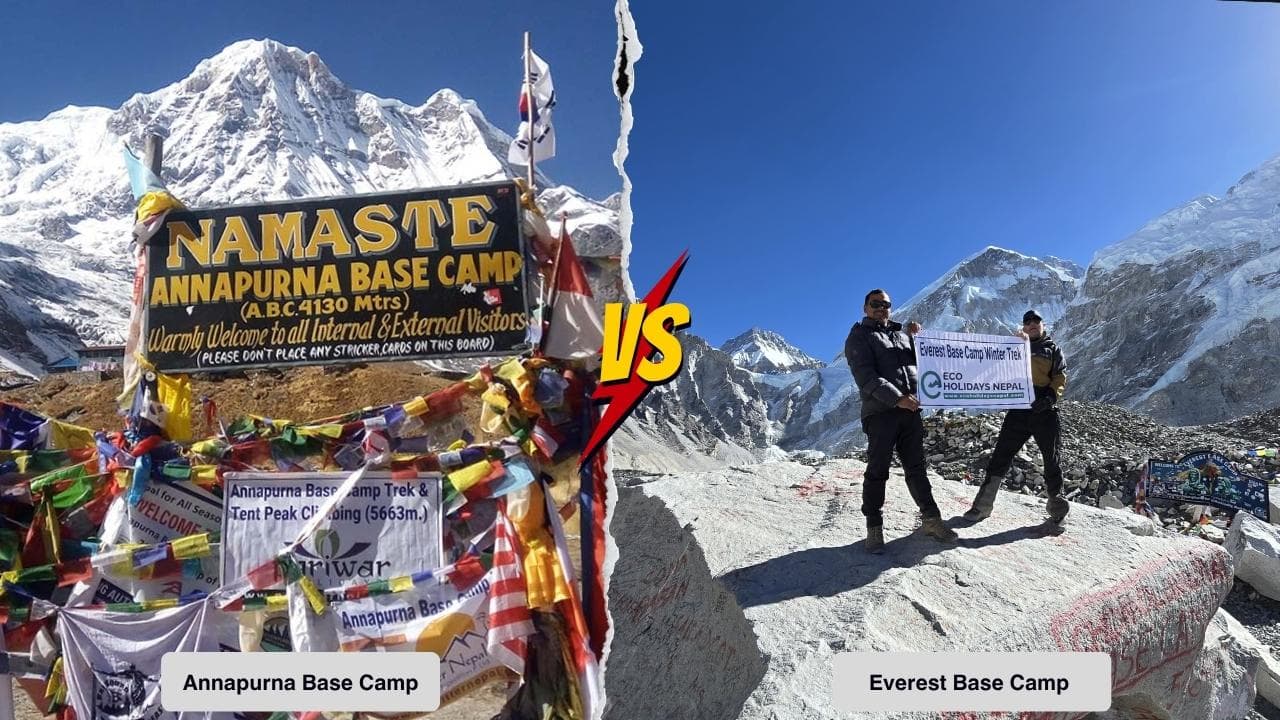
Nepal is one of the best places in the world for trekking. Every year, thousands of trek lovers come here to walk through beautiful mountain trails, see the Himalayas up close, and experience local culture. Among all the trekking routes in Nepal, two trails are especially popular for beginners: Everest Base Camp (EBC) and Annapurna Base Camp (ABC).
For many first-time trekkers, choosing between these two famous treks can be confusing. Both offer incredible views of the Himalayan mountains, unique village life, and an unforgettable trekking experience. But they are also quite different in terms of altitude, difficulty, duration, and overall trekking experience.
The Everest Base Camp Trek takes trekkers to an altitude of about 5,364 meters, deep into the Everest region. It usually takes around 12 to 14 days and passes through famous Sherpa villages like Namche Bazaar and Tengboche. Trekkers also get amazing views of some of the world's highest mountains, including Mount Everest.
On the other hand, the Annapurna Base Camp Trek reaches around 4,130 meters, and it is usually shorter. It takes about 7 to 10 days. The trail passes through green forests, traditional Gurung and Magar villages, and beautiful valleys before reaching the stunning Annapurna Sanctuary surrounded by giant Himalayan peaks.
Both of these treks are excellent choices for beginners, but each offers a slightly different experience. Some trekkers prefer the iconic journey to Everest Base Camp, while others enjoy the shorter and greener route to Annapurna Base Camp. In this blog, we will compare EBC vs ABC for first-time trekkers, looking at difficulty, scenery, cost, culture, and trekking experience to help you decide which trek is right for you.
Trek Overview: What Makes EBC and ABC Different?
Before choosing between these two famous treks, it is important to understand how the Everest Base Camp (EBC) and Annapurna Base Camp (ABC) treks are different. Both are amazing Himalayan journeys, but the trekking experience, landscape, and travel style are not the same.
The Everest Base Camp Trek is located in the Khumbu region of eastern Nepal. The journey usually begins with a short but exciting mountain flight from Kathmandu to Lukla, one of the world's most famous mountain airports. From Lukla, trekkers walk through beautiful Sherpa villages such as Phakding, Namche Bazaar, Tengboche, and Dingboche before reaching the Everest Base Camp at 5,364 meters.
Along the way, trekkers see some of the most famous mountains in the world, including Mount Everest, Lhotse, Nuptse, and Ama Dablam. The region is also known for its strong Sherpa culture, Buddhist monasteries, prayer flags, and historic mountaineering routes.
The Annapurna Base Camp Trek, on the other hand, is located in the Annapurna region of central Nepal. The trek usually starts after a short drive from Pokhara to villages like Nayapul or Jhinu Danda. From there, the trail passes through beautiful forests, terraced farms, rivers, and traditional Gurung and Magar villages.
The trek gradually climbs into the Annapurna Sanctuary, a natural mountain amphitheater surrounded by huge peaks like Annapurna I (8,091 m), Machhapuchhre, and Hiunchuli. The base camp itself sits at 4,130 meters, lower than Everest Base Camp but still offering spectacular Himalayan views.
In overall, EBC is a classic high-altitude adventure, while ABC is a shorter trek with more diverse landscapes and easier access. Understanding these basic differences helps first-time trekkers choose the trek that best matches their time, fitness, and travel goals.
Difficulty Level: Which Trek Is Easier for Beginners?
One of the most important things first-time trekkers consider is the difficulty level of the trek. Both the Everest Base Camp (EBC) Trek and the Annapurna Base Camp (ABC) Trek are achievable for beginners, but they are not equally challenging.
The Everest Base Camp Trek is generally considered more difficult. One major reason is the higher altitude. Everest Base Camp sits at 5,364 meters, where the air becomes thinner, and oxygen levels are lower. Because of this, trekkers must walk slowly and take proper acclimatization days to avoid altitude sickness. The trek also takes around 12 to 14 days, and daily walking hours are usually 5 to 7 hours.
The trail itself is not technical, but the combination of long trekking days, cold weather, and high altitude can make the journey physically demanding. In some sections, trekkers walk through rocky paths, glacier valleys, and steep uphill climbs.
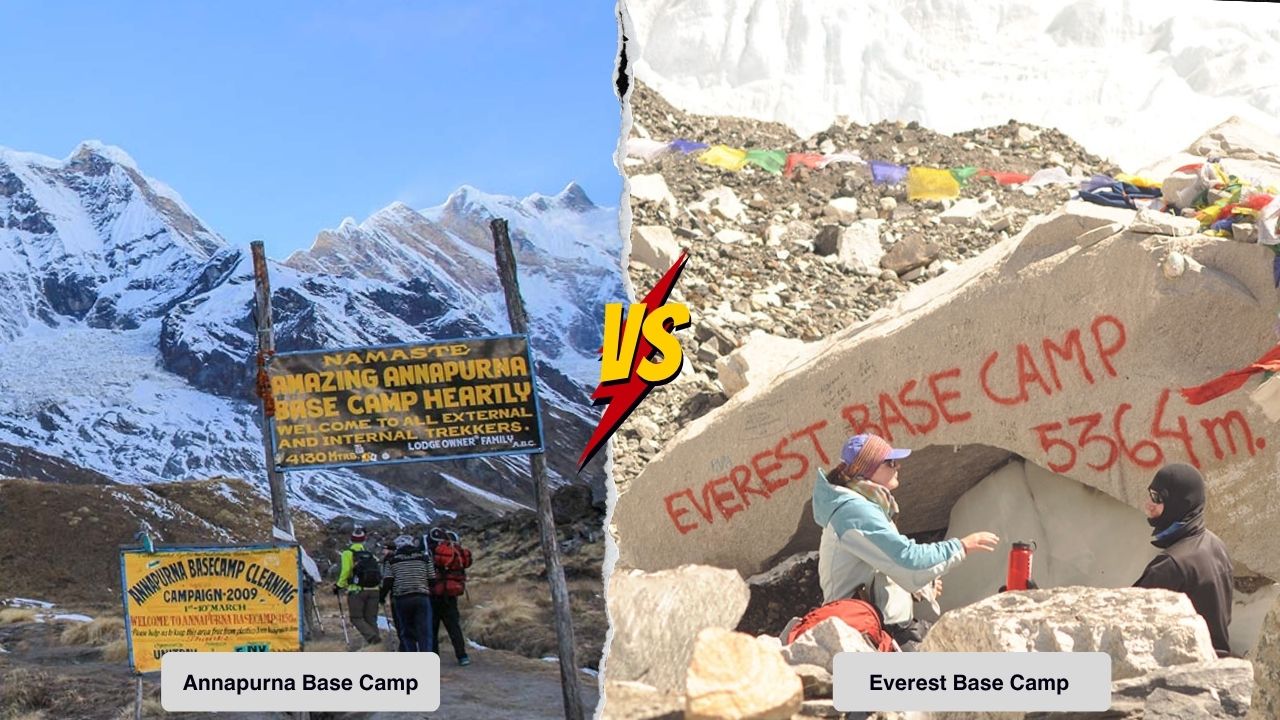
The Annapurna Base Camp Trek, however, is often seen as more beginner-friendly. The maximum altitude is 4,130 meters, which is significantly lower than Everest Base Camp. This means the risk of altitude sickness is generally lower.
Another advantage is the shorter trekking duration. Most ABC treks take 7 to 10 days, and the daily walking distance is usually more manageable. The trail also passed through forests, villages, and stone stair trails, making the journey feel less extreme compared to the rugged Everest region.
Many guiding experts often recommend Annapurna Base Camp as a great first Himalayan trek. It allows beginners to experience high mountains without pushing the body too hard. So, EBC is a bigger challenge and requires more preparation, while ABC offers a slightly easier and shorter adventure, making it a popular choice for first-time trekkers who want to explore the Himalayas comfortably.
Scenery and Landscapes: Which Trek Is More Beautiful?
One of the biggest reasons people trek in Nepal is to experience the incredible beauty of the Himalayas. Both the Everest Base Camp (EBC) and Annapurna Base Camp (ABC) treks offer stunning scenery, but the landscapes along the trails are quite different.
The Everest Base Camp Trek is famous for its dramatic high-mountain environment. As trekkers move higher into the Khumbu region, the landscape becomes more rugged and wild. You will see rocky trails, massive glaciers, deep valleys, and towering snow-covered peaks. One of the highlights of the trek is the view of the Khumbu Icefall, a huge mountain glacier near Everest.
Along the trail, trekkers can enjoy spectacular views of the world's most famous mountain, including Mount Everest (8,848.86m), Lhotse, Nuptse, Thamserku, and the beautiful Ama Dablam. The scenery feels very raw and powerful, which is why many trekkers describe the Everest region as a true high-altitude Himalayan adventure.
The Annapurna Base Camp Trek, however, offers a more diverse landscape. The journey begins in green hills with terraced farms, rivers, and small villages. As trekkers climb higher, the trail passes through dense rhododendron forests, bamboo groves, and waterfalls.
During spring, these forests become especially beautiful when the rhododendron flowers bloom in bright red and pink colors. Gradually, the forest opens up, and the trail leads into the Annapurna Sanctuary, a natural bowl surrounded by massive peaks.
At Annapurna Base Camp, trekkers stand in the middle of a circle of mountains, including Annapurna I, Machhapuchhre (Fishtail), Annapurna South, and Hiunchuli. This close mountain view makes the experience very special.
In summary, EBC offers dramatic glaciers and iconic high peaks, while ABC provides greener trails and a wider variety of landscapes. Both treks are incredibly beautiful, but the type of scenery is different.
Trek Duration and Accessibility: EBC vs ABC for First-Time Trekkers
For first-time trekkers, time and accessibility are very important factors when choosing a trek. The Everest Base Camp (EBC) and Annapurna Base Camp (ABC) treks differ quite a lot in how long they take and how easy they are to reach.
The Everest Base Camp Trek usually takes around 12 to 14 days to complete. This includes important acclimatization days in places like Namche Bazaar and Dingboche. These rest days help trekkers adjust to the high altitude and reduce the risk of altitude sickness.
To start the trek, travellers must first take a mountain flight from Kathmandu or Ramechhap to Lukla. The flight takes about 30-40 minutes, but it is known for being weather-dependent. Sometimes flights can be delayed or even cancelled due to clouds or strong winds.\
Because of this, trekkers often need to keep extra buffer days in their schedule. After landing in Lukla, the journey continues on foot through several villages before finally reaching Everest Base Camp.
The Annapurna Base Camp Trek is generally shorter and easier to access. Most ABC treks take about 7 to 10 days, depending on the itinerary. The journey usually begins with a drive from Pokhara, which takes around 2 to 3 hours to reach the starting point of the trek.
Unlike the Everest region, there is no mountain flight required, which makes travel planning simpler and more reliable. This is one reason why many first-time trekkers feel more comfortable choosing ABC.
Thus, ABC is a great option for travellers who have limited time but still want to complete a Himalayan trekking experience. To sum it up, EBC requires more time and includes a mountain flight, while ABC is quicker to reach and easier to fit into a shorter travel schedule.
Cost Comparison: Which Trek Is More Budget-Friendly?
Another important factor for many first-time trekkers is the cost of the trek. While both Everest Base Camp (EBC) and Annapurna Base Camp (ABC) offer amazing Himalayan experiences, the overall budget required for each trek can be quite different.
The Everest Base Camp Trek is usually more expensive. On average, a standard guided trek costs between $1,300 and $2,500 per person, depending on the trekking company, services included, and season. One of the main reasons for the higher price is the flight to Lukla, which normally costs around $180 to $220 one way.
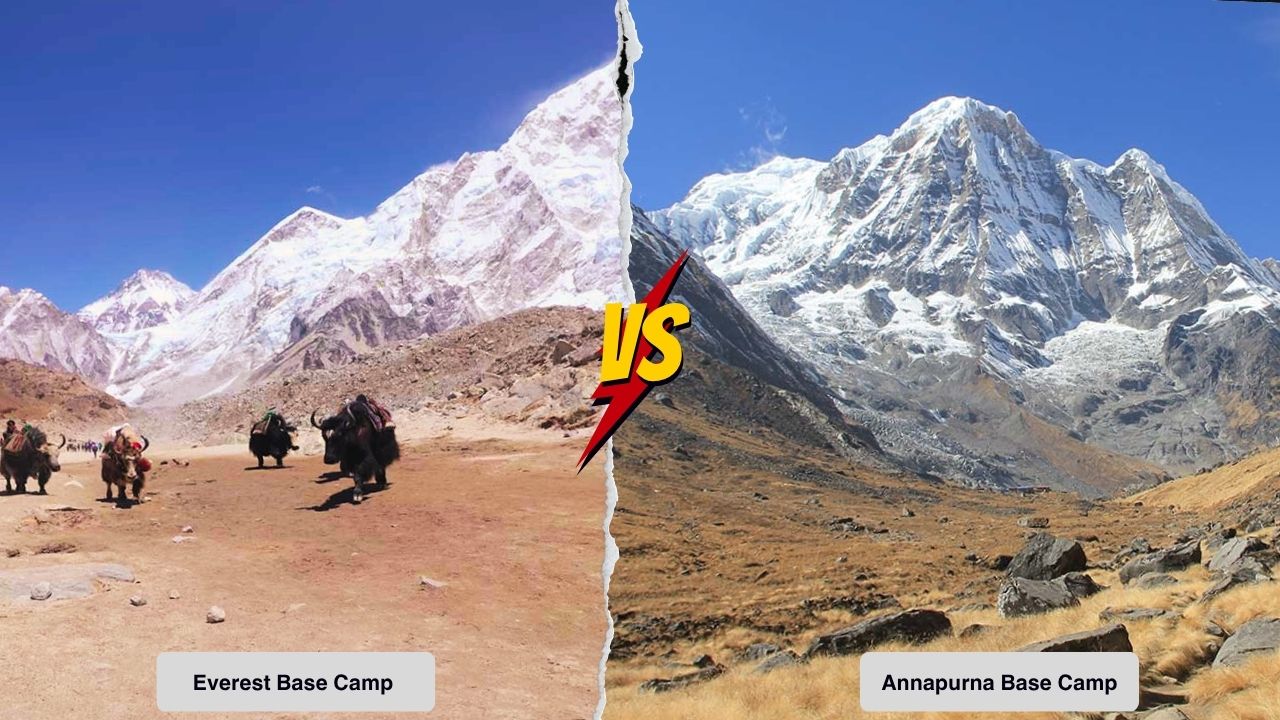
In the Everest region, most supplies such as food, gas, and building materials are transported by yaks, porters, or helicopters. Because of this, food and accommodation prices in tea houses are higher compared to other trekking regions in Nepal. For example, a simple meal at higher altitudes can cost $8 to $12, which is more expensive than in lower regions.
The Annapurna Base Camp Trek is generally more budget-friendly. Most trekking packages cost around $700 to $1,500, depending on the itinerary and services. One big advantage is that there is no need for a domestic flight, since the trek starts after a short drive from Pokhara.
Food and accommodation are also slightly cheaper because the Annapurna region has better road access in some areas, making transportation easier. Tea houses are comfortable, and meals usually cost $5 to $8 on average.
Because of these reasons, ABC is a better option for travellers with a limited budget who still want a full Himalayan trekking experience. Overall, the EBC is more expensive due to flights and remote logistics, while ABC offers a more affordable trekking adventure for beginners.
Culture and Trekking Experience
Trekking in Nepal is not only about mountains. It is also about meeting local people, learning about traditions, and experiencing life in Himalayan villages. Both the Everest Base Camp (EBC) and Annapurna Base Camp (ABC) treks offer rich cultural experiences, but the cultures you see along the trails are slightly different.
The Everest region is home to the famous Sherpa Community, known around the world for their mountaineering skills and strong mountain traditions. As trekkers walk through villages like Namche Bazaar, Khumjung, and Tengboche, they can see Buddhist monasteries, prayer flags, Mani walls, and spinning prayer wheels.
One of the most special cultural highlights of the EBC trek is visiting Tengboche Monastery, one of the most important Buddhist monasteries in the region. The Everest area also has a strong connection to the history of Himalayan climbing, since it is the gateway to the world's highest mountain.
The Annapurna Base Camp Trek, on the other hand, passes through villages mainly inhabited by Gurung and Magar communities. These villages are known for their warm hospitality and traditional lifestyles. Trekkers often see stone houses, terraced farmland, ms and local farming activities along the trail.
The Annapurna region also offers a more peaceful village atmosphere because it is less focused on mountaineering compared to the Everest region. Many trekkers feel that the villages here still maintain a very authentic and traditional mountain culture.
Both treks follow the tea house trekking system, where trekkers stay in small local lodges and eat home-style meals prepared by the hosts. This allows trekkers to connect with local people and learn about mountain life.
In simple words, EBC offers a strong Sherpa and Buddhist culture connected to Everest climbing, while ABC provides a quieter village experience with traditional Gurung and Magar communities.
EBC vs ABC for First-Time Trekkers: Which One Should You Choose?
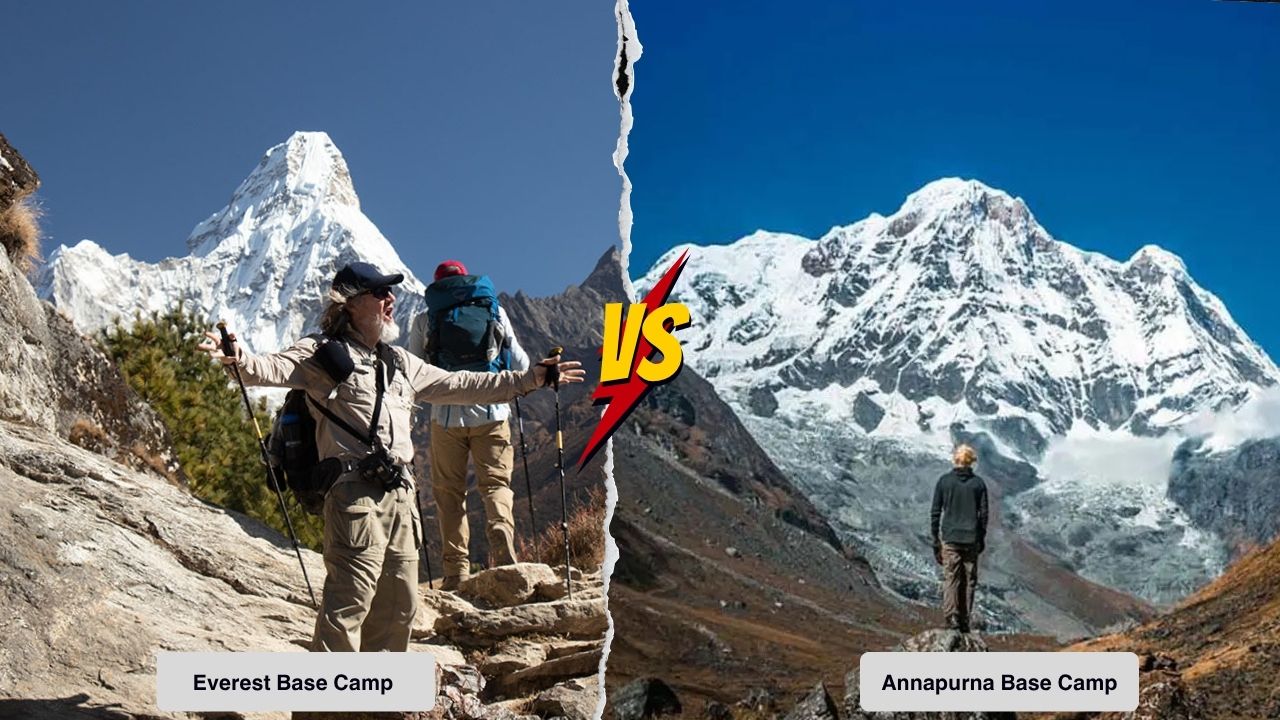
Choosing between the Everest Base Camp (EBC) and Annapurna Base Camp (ABC) treks can be a tough decision for first-time trekkers because both offer unforgettable Himalayan experiences. However, several key factors, such as time, budget, fitness, and personal preference, can help you to decide which trek is the right fit for you.
The Everest Base Camp Trek is one of the most iconic treks in the world. Trekking here allows you to walk among some of the highest mountains on the planet, including Mount Everest, Lhotse, Nuptse, and Ama Dablam. You will experience the rich Sherpa culture, visit Buddhist monasteries, and stay in villages like Namche Bazaar and Tengboche, which are steeped in mountaineering history.
However, EBC comes with challenges. The trek is longer, usually takes 12 to 14 days, and reaches a higher altitude of 5,364 meters, which increases the risk of altitude sickness. The daily trekking hours are also longer, and the region is colder, making physical preparation important. Additionally, the trek is more expensive due to the Lukla flight and higher tea house prices.
The Annapurna Base Camp Trek is generally considered more beginner-friendly. The trek is shorter, usually taking 7 to 10 days, and reaches a maximum altitude of 4,130 meters, which is lower than EBC. The trail passes through beautiful green forest, rivers, waterfalls, lakes, and traditional Gurung and Magar villages, leading to the stunning Annapurna Sanctuary surrounded by towering peaks.
ABC is also more budget-friendly, easier to plan, and accessible via a short drive from Pokhara without requiring a mountain flight. This makes it ideal for first-time trekkers who want a full Himalayan experience with less physical stress.
Many trekking companies, including Eco Holidays Nepal, recommend starting with ABC if it is your first high-altitude trek. It helps you to gain confidence and experience before attempting higher -altitude treks like EBC.
In conclusion, choose ABC for a shorter, easier, and more affordable first trek and EBC if you are ready for a challenging, iconic Himalayan adventure. Both treks will provide memories that last a lifetime.