
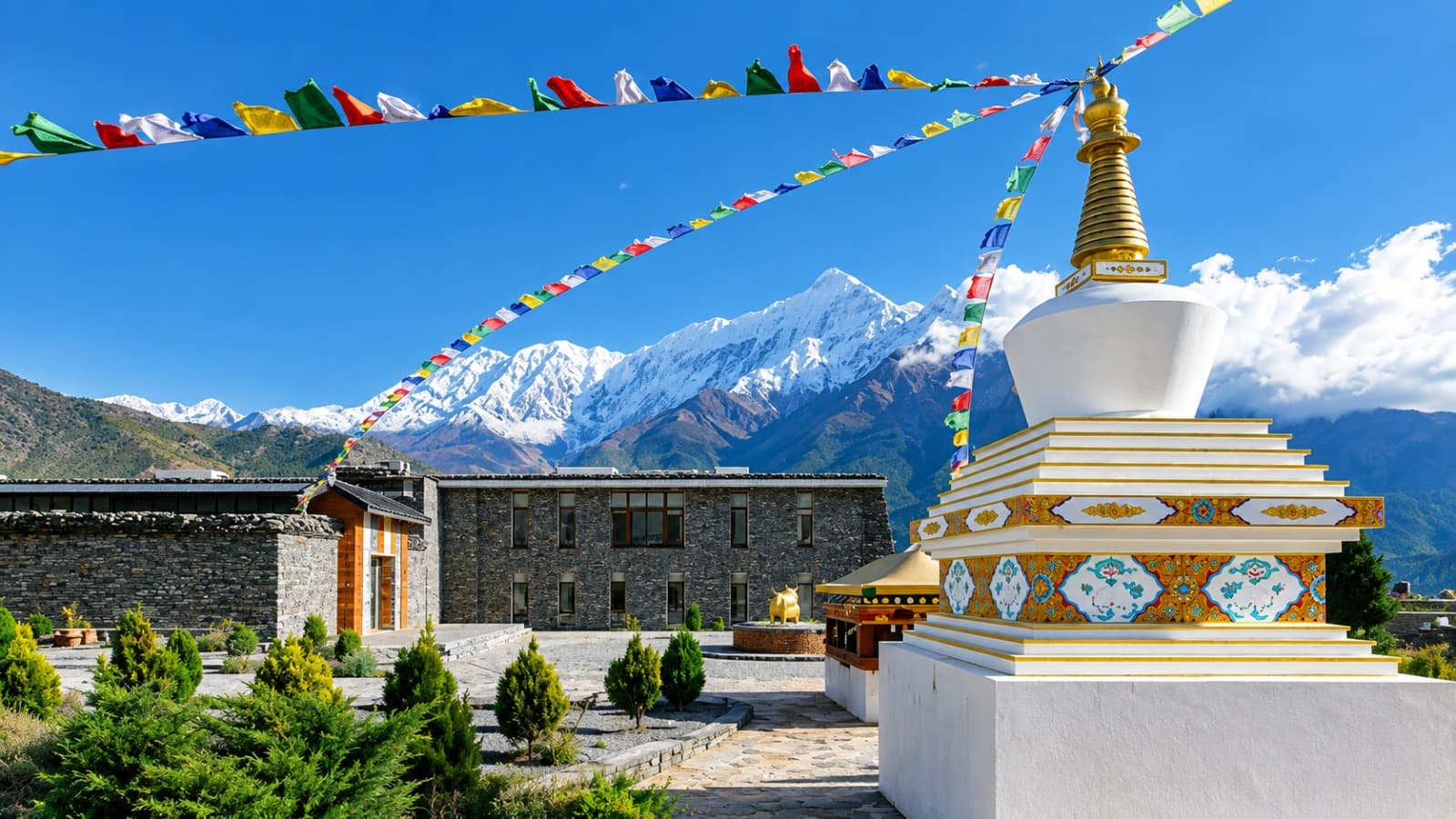
In July 2026, Robb Report published its "50 Greatest Luxury Hotels on Earth" list, and the name at the top was not in Paris or Dubai. It was Shinta Mani Mustang, a 29-suite property on a hillside above Jomsom, Nepal, at 2,800 metres. It beat Rwanda's Singita Kwitonda & Kataza Lodge, Scotland's Hope Lodge, and Japan's Park Hyatt Tokyo, judged by a panel of 24 veteran luxury travel advisers who curate journeys for the world's most discerning clients. What that result actually reveals is bigger than one hotel.
Nepal now has one of the densest concentrations of serious luxury lodging anywhere in the world, built directly into its trekking infrastructure, not clustered in Kathmandu or Pokhara, but strung out along the actual trails, spaced a walking day apart, from 1,220 metres up to 4,250 metres. Three lodge groups did most of the work here: Mountain Lodges of Nepal (which absorbed both the old Yeti Mountain Homes brand and Ker & Downey Nepal), Everest Summit Lodges, and a scattering of independent standouts including Hotel Everest View, Tiger Mountain Pokhara Lodge, and Shinta Mani Mustang itself.
This is a proper, route-by-route accounting of what is actually out there in the Everest region, the Annapurna Circuit and Sanctuary, and Upper Mustang with real numbers: elevation, room counts, what is included, and what makes each property worth the walk.
The Everest Region: Two Rival Lodge Chains and One World-Record Hotel
The classic Everest Base Camp trail runs Lukla to Phakding, Monjo, Namche Bazaar, Tengboche, Dingboche, Lobuche, and up to Gorak Shep. For most of its history, this route meant teahouses functional but basic. That changed with the arrival of two competing premium lodge networks, plus one genuine outlier that predates both of them by decades.
Hotel Everest View: The Original, and Still The Highest
Elevation: 3,880m (13,000ft), Guinness World Record holder for highest-placed hotel on earth since 2004
Rooms: 12
Rate: Roughly $320 to $500 per person per night on a twin-sharing basis, up to around $3,275 for full helicopter packages
Location on Trail: Syangboche, a short detour above Namche Bazaar
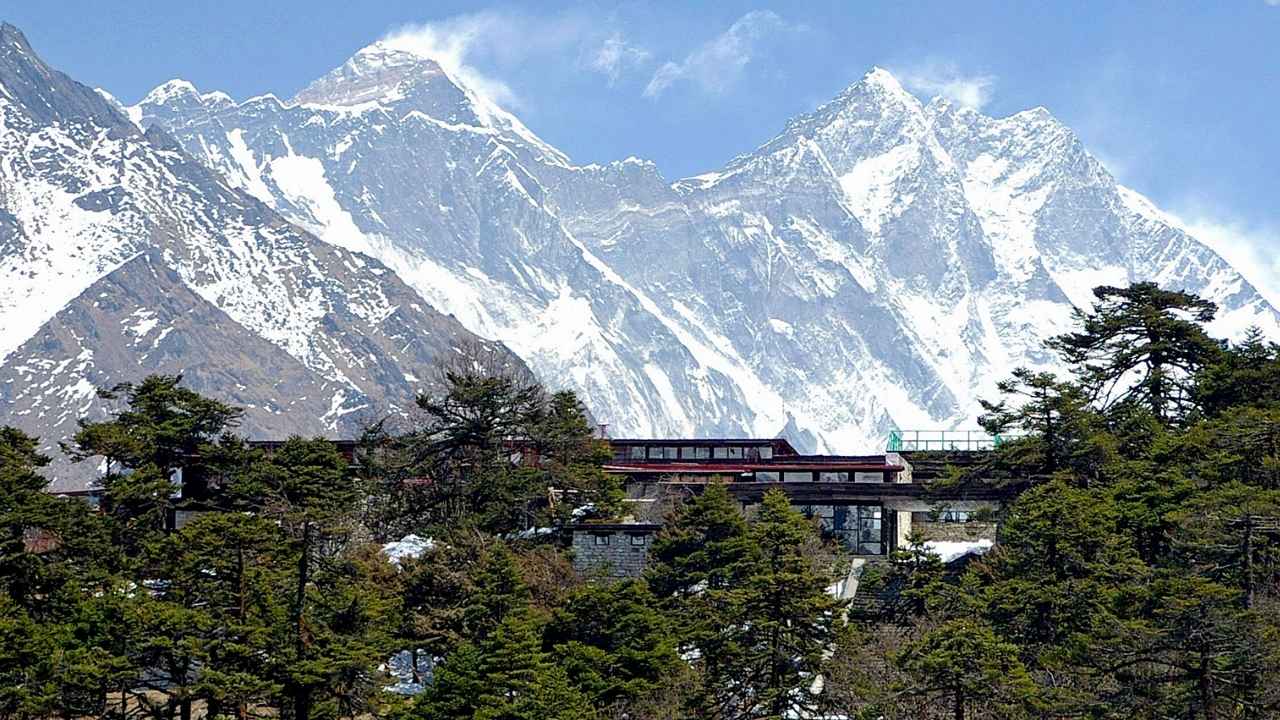
Built in 1971 by Japanese mountaineer Takashi Miyahara, every piece of material was carried in by hand or helicopter, since no road has ever reached it. Hotel Everest View is the property that proved luxury lodging at extreme altitude was even possible. All 12 rooms face Everest (8,848m), Ama Dablam (6,812m), and Nuptse (7,861m) directly, each with an en-suite bathroom, a private stone balcony, electric blankets, a room heater, and on-request supplemental oxygen.
Hundreds of trekkers hike up from Namche Bazaar (3,440m) purely to acclimatize here before continuing higher, which means the hotel doubles as a working piece of altitude strategy on the route, not just a stopover. It remains, by most measures, the most expensive single-night stay in the Everest region.
Yeti Mountain Home: Now Folded Into Mountain Lodges of Nepal
Locations on Trail: Lukla, Phakding, Monjo, Namche Bazaar, Thame, Deboche, Kongde Rooms Per Lodge: 10 to 20
Rate: Roughly $230 to $400 per night
This was the first serious attempt at a proper multi-stop luxury chain on the EBC trail, and it's since been absorbed into the broader Mountain Lodges of Nepal (MLN) brand. Lodges are spaced a short day's walk apart specifically to allow gradual altitude gain from Lukla to Namche Bazaar, on to the Sherpa village of Thame, and finally up to Kongde at 4,250m, the highest point in the network. Every lodge shares the same core standard: electric blankets, good linens, hot running water, king or twin beds finished in traditional Khumbu wood styling, and dining rooms serving organic vegetables grown in the lodge's own greenhouses.
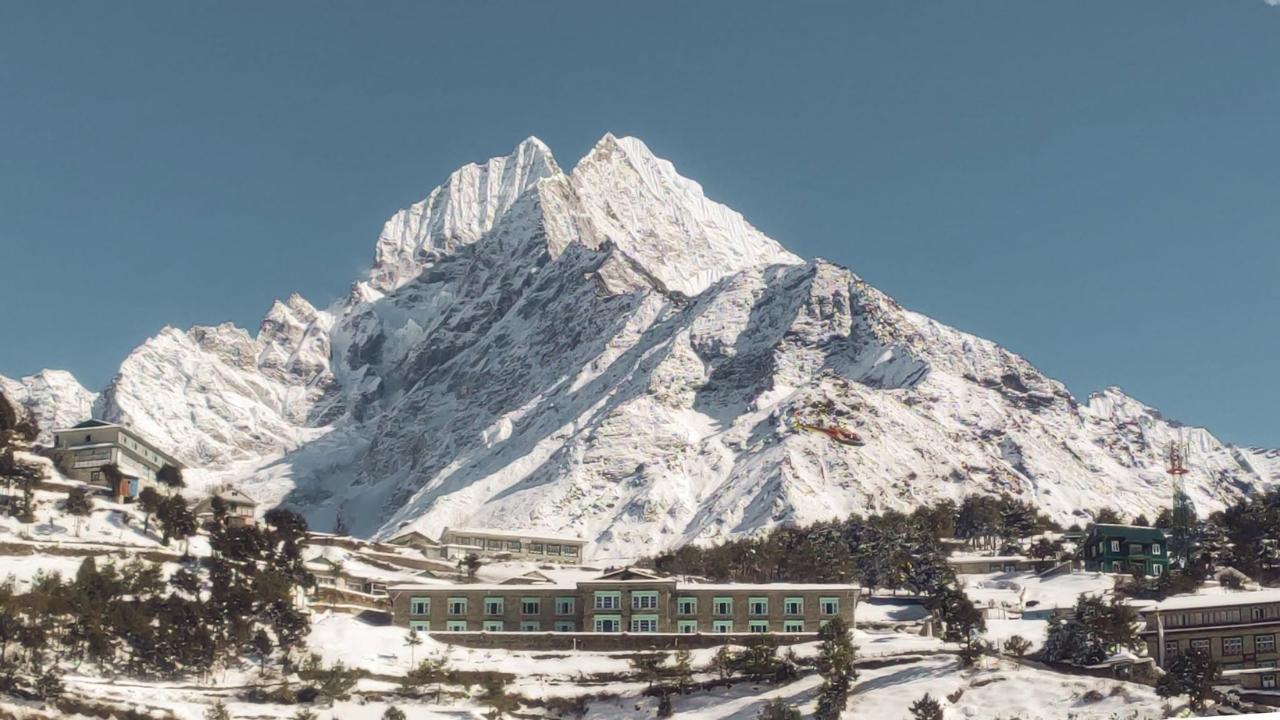
The Namche Lodge, perched on the upper slopes of the Sherpa capital, has its own spa (Himalayan Healers) and was voted the network's best lodge in past guest surveys. The Phakding Lodge (2,610m/8,563ft) sits on the banks of the Dudh Kosi River across from pine-forested cliffs, and functions as most trekkers' first taste of upgraded comfort, a half-day's walk out of Lukla. Kongde Lodge, at 4,250m, is the network's highest and most remote outpost, genuinely alpine, reached only by a demanding side trail off the main EBC route.
**Keep Reading: Everest Base Camp Trek with Helicopter Return– Reach Everest Base Camp. Leave with a View Few Ever See**
Everest Summit Lodges: The Quieter Alternative Route
Locations on Trail: Lukla, Monjo, Mende, Tashinga, Pangboche
Rate: Comparable premium band to Yeti Mountain Home/MLN
Signature Approach: Deliberately routes trekkers around, not through, the busiest villages
Everest Summit Lodges runs a parallel network that overlaps the main trail but frequently detours around the busiest tourist choke points. Rather than staying in Namche Bazaar itself, guests on this circuit stay at Mende, just off the main trail between Namche and the Thame Valley at almost 3,900m, with views of Kongde Ri, Thamserku, Kang Taiga, and Khumbila. Tashinga, set in pine forest near Pangboche, functions as a quieter alternative to Tengboche for trekkers heading toward Ama Dablam Base Camp (4,295m).
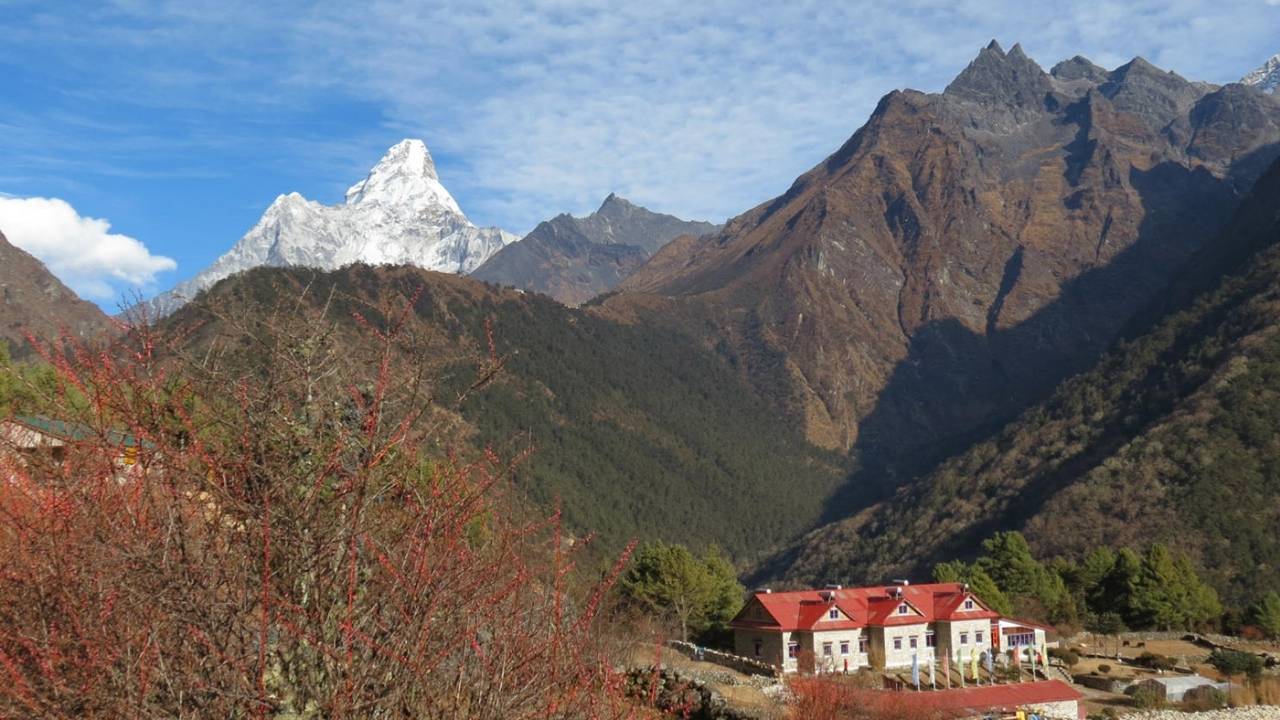
The Pangboche lodge itself sits beside one of Nepal's oldest monasteries, framed by Everest, Ama Dablam, Thamserku, Kang Taiga, and Kongde simultaneously about as concentrated a view of 6,000-plus-metre peaks as exists anywhere on the route. All five lodges avoid firewood for hot water, relying on gas or solar power instead a deliberate environmental choice given how much wood-burning has historically strained Khumbu's forests.
The Himalayan Lodge Phakding: The Boutique Outlier
Rooms: 14 private riverside cottages
Elevation: 2,610m, same village as MLN's Phakding property
Signature Approach: Heated onsen-style spa pool, a genuine rarity at this altitude
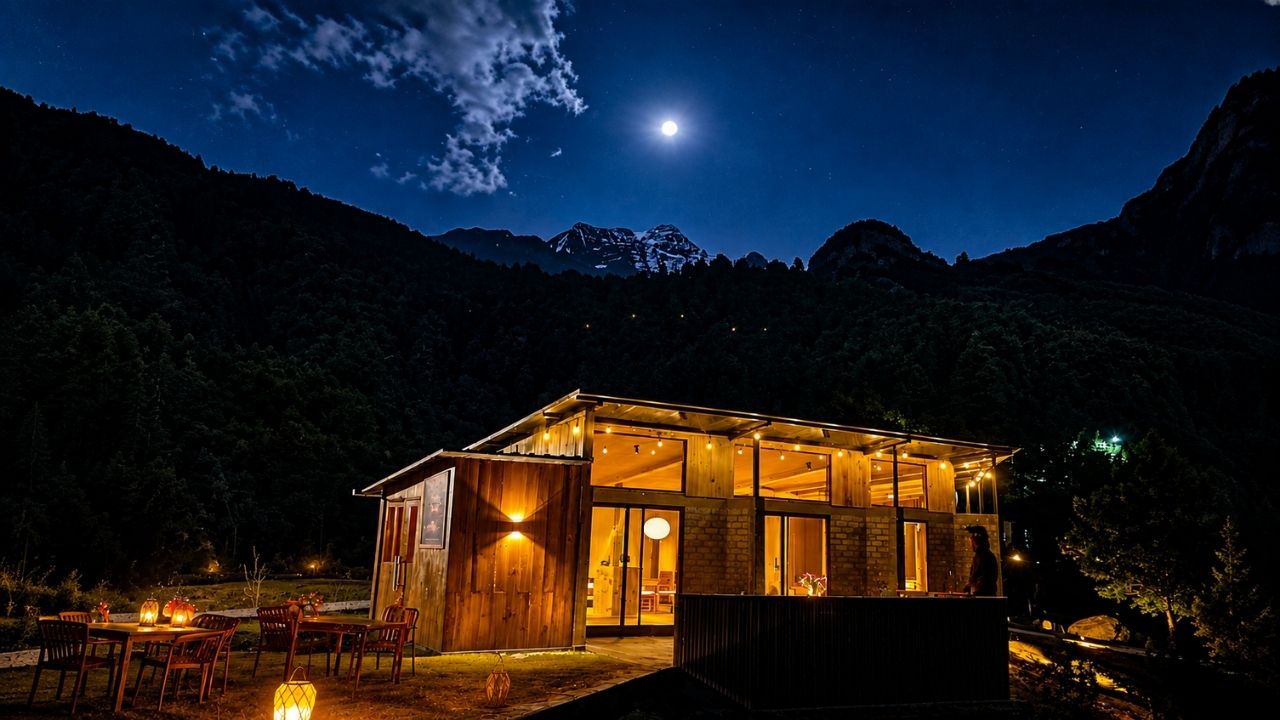
Rather than one hotel building, this is 14 individual cottages spread along the riverbank, each with double-glazed windows, insulated walls, and en-suite hot-water bathrooms. Its wellness offering a heated outdoor spa pool plus massage service has no real equivalent this early on the trail, and its library and fireside lounge lean hard into the mountaineering-heritage aesthetic that a lot of Everest region lodges reach for but few pull off this well.
What a Luxury Everest Base Camp Trek Itinerary Actually Looks Like?
Most operators combine three nights at a 5-star Kathmandu hotel with a run of these premium lodges Lukla to Phakding to Namche (two nights for acclimatization) to Tengboche or Deboche to Dingboche and increasingly finish with a helicopter flight out from Gorak Shep rather than the multi-day walk back down. The price gap against a standard teahouse trek is real: budget beds run $10 to $50 a night, while the premium lodges run $230 to $400, with Hotel Everest View sitting well above that.
What buys that difference is mostly about recovery private en-suite rooms, real heating, and a 4:1 guide-to-client ratio on organized luxury treks versus roughly 1:12 on standard group departures. Season matters more here than the marketing usually admits. Spring (March to May) and autumn (late September to November) are when nearly every one of these lodges runs at or near capacity, since those windows offer the clearest mountain visibility and the most stable weather for the Lukla flight, which is itself one of the more weather-dependent legs of any Everest itinerary a poor forecast in Kathmandu or Lukla can strand an entire luxury itinerary for a day or more regardless of what's booked at the other end.
Winter access is possible but genuinely cold even inside heated rooms, since electric blankets and room heaters only do so much against nights that regularly drop below freezing at Dingboche and Lobuche. Monsoon season (June to August) is the one window nearly every operator, including Shinta Mani Mustang further west, either closes for or actively discourages, since cloud cover erases the views that justify most of these rates in the first place.
The Annapurna Region: From Foothill Comfort to High-Altitude Firsts
Annapurna's luxury lodging splits into two distinct tiers that do not get talked about together often enough: the gentle, low-altitude comfort-trek circuit around Pokhara, and a genuinely new wave of high-altitude luxury that has only arrived on the Annapurna Circuit in the last couple of years.
Mountain Lodges of Nepal/ Ker & Downey circuit: The Original Comfort Trek
Locations on Trail: Sanctuary Lodge (Birethanti), Himalaya Lodge (Ghandruk), Mala Lodge (Majgaon), Basanta Lodge (Dhampus), Tomijong and Landruk lodges
Elevation Range: Roughly 1,100m to 2,000m
Signature Service: Nightly "Happy Hour" (6 to 7 pm) around a lit fire pit through winter
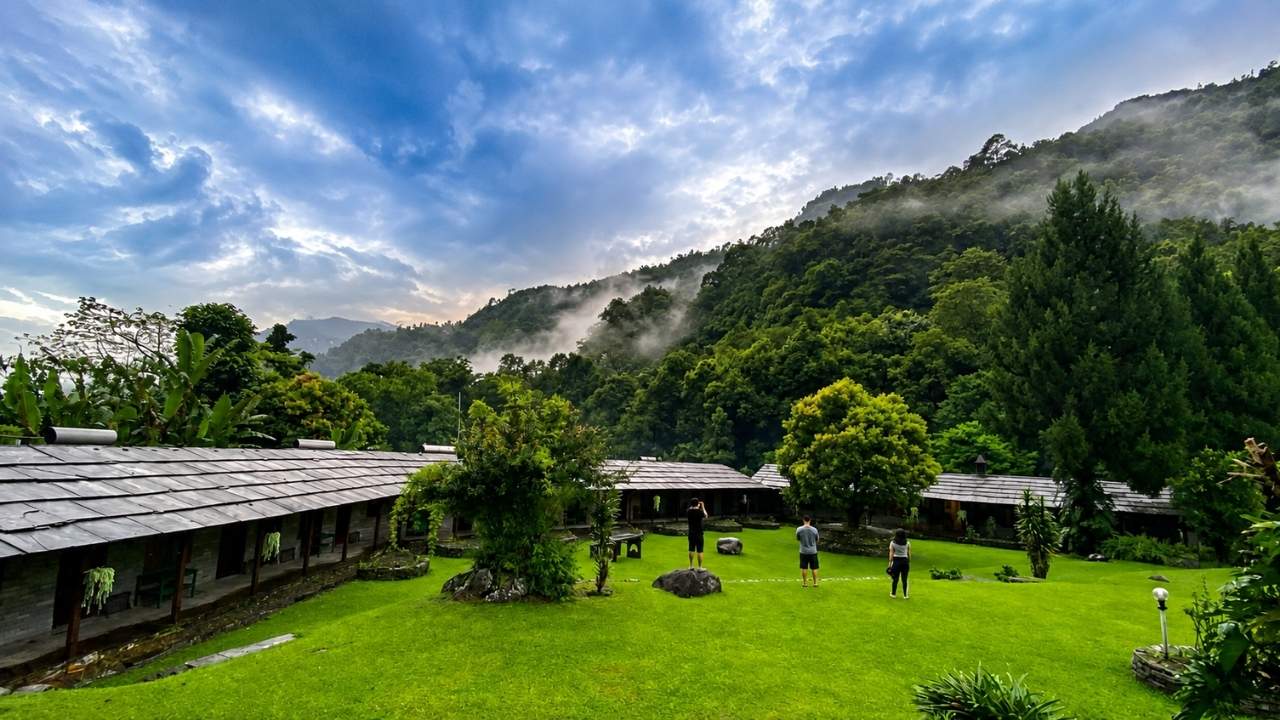
This network, built originally by Ker & Downey Nepal and now under the Mountain Lodges of Nepal banner, was designed specifically to introduce first-time trekkers to the Himalayas without the altitude or physical demands of Everest or Mustang. The loop runs from Pokhara through Nayapul into Gurung and Magar villages: Birethanti, Ghandruk, Landruk, Dhampus, and Majgaon, with Annapurna I, III, and V, Annapurna South, Machhapuchhre (Fishtail), and Dhaulagiri visible for most of the route.
Mala Lodge, the newest addition to the circuit, sits in Majgaon among rice terraces and beekeeping villages, reached by a climb of under two hours from Lumle, with Machhapuchhre looming directly overhead. Every lodge on this circuit follows a consistent formula: en-suite hot showers, Western toilets, down pillows and hot water bottles on the beds, and down jackets provided for guests who did not pack warm enough. It is a deliberately low-intensity trek with shorter walking days, gentler grades built for people who want the cultural and visual reward of the Himalayas without the acclimatization planning the higher routes demand.
This particular network has been running for more than three decades, which shows in how settled the whole operation feels compared to some of the newer high-altitude entrants. The lodges were originally built and run by Ker & Downey Nepal, a name that still carries weight with repeat guests and travel advisers even after the rebrand to Mountain Lodges of Nepal folded it into a single company alongside the old Yeti Mountain Home network.
Along the trail, walkers pass beneath the cliffs where Nepal's traditional honey hunters climb exposed rope ladders to harvest wild cliffside honey from the Modi River valley a detail that has nothing to do with the lodges themselves and everything to do with why the region keeps drawing people back season after season.
**Read Next: Annapurna Circuit Trekking– Nepal's Most Diverse Trekking Adventure**
Manang Lodge and Chame Lodge: Genuinely New, Genuinely High
Elevation: 2,650m to 3,540m
Rooms: 14 each
Recognition: Manang Lodge was named one of TIME's "World's Greatest Places to Stay" in 2026
Signature Service: Picnic excursions to Annapurna IV's lower base camp; winter snow leopard spotting
This is the most significant recent development in Annapurna lodging, and it is easy to miss if you are only looking at the Sanctuary side of the region. Mountain Lodges of Nepal opened Manang Lodge as, in TIME's words, "the first upscale accommodation" on the higher stretches of the Annapurna Circuit, a 14-room, stone-built property perched above the yak-grazed Marsyangdi River valley at nearly 3,540m, with floor-to-ceiling windows framing the Annapurna range and heated beds to offset the altitude.
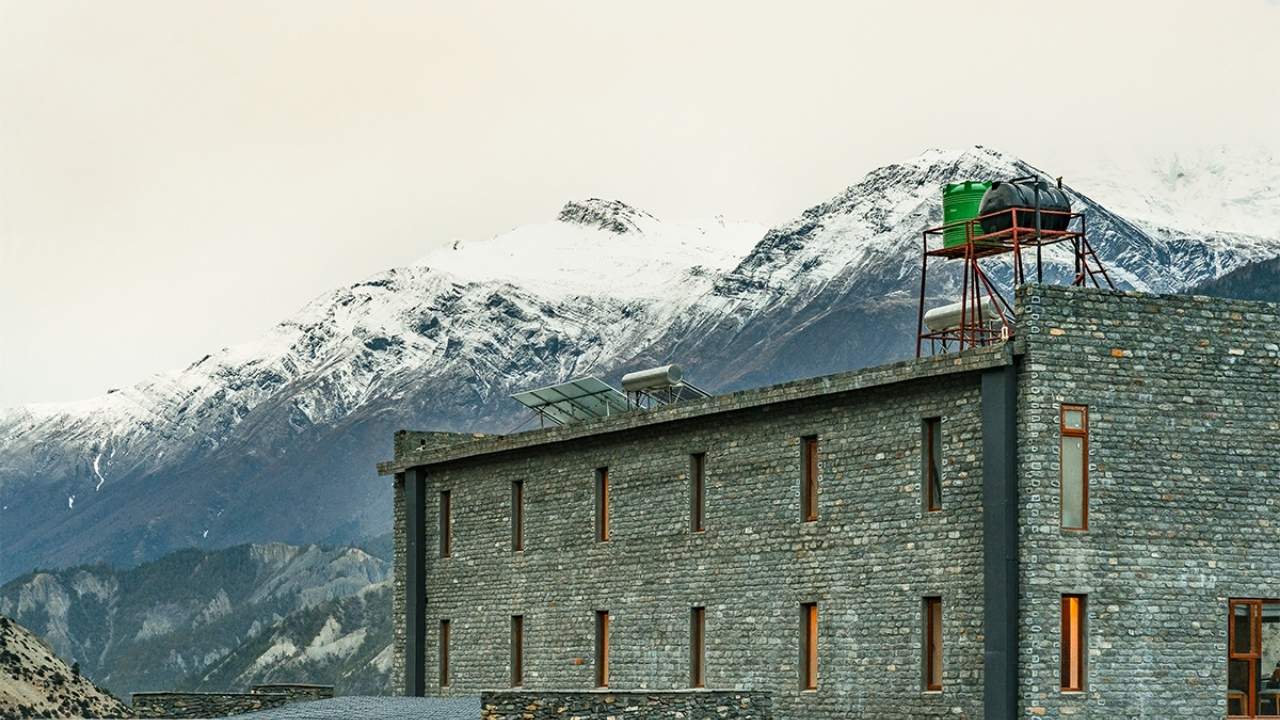
Chame Lodge, a day's walk below at roughly 2,650m, offers the same standard ensuite bathrooms, heated blankets, full-board meals, and a library beneath Annapurna II and Lamjung Himal. What makes Manang notable beyond the amenities is timing: road construction has compressed what used to be a month-long, 150-mile Annapurna Circuit trek into as little as eight days, and Manang is now reachable by a roughly 10-hour drive from Kathmandu or a quick helicopter hop from Pokhara, meaning this high-altitude luxury lodge is considerably more accessible than its elevation would suggest.
From the lodge, guests can walk to the 600-year-old Braga Monastery, glacial lakes, sacred meditation caves, and the quieter trail toward Annapurna IV's lower base camp, and the region is considered one of Nepal's better winter spots for glimpsing snow leopards.
Tiger Mountain Pokhara Lodge: The Pre- and Post-Trek Anchor
Elevation: Approximately 1,220m (4,000ft)
Rooms: 18 to 19 stone cottages across 7 acres
Opened: 1998, with Sir Edmund Hillary leading the opening ceremony
Signature Service: Infinity-edge mountain-view pool; Colonel Jimmy's Library, a dedicated collection of Himalayan mountaineering literature
Set on a hilltop ridge roughly 1,000 feet above the Pokhara Valley, a 25 to 40 minute drive from town, Tiger Mountain Pokhara Lodge is not a stop mid-trek; it is the bookend most Annapurna luxury itineraries build around, before or after the walk. Its 18 to 19 hand-cut stone cottages (accounts vary slightly by source) come with private verandas, Tibetan hand-knotted rugs, and views of Machhapuchhre, Dhualagiri, Annapurna, and Manaslu, three of the ten highest peaks on earth, visible without moving from the property.
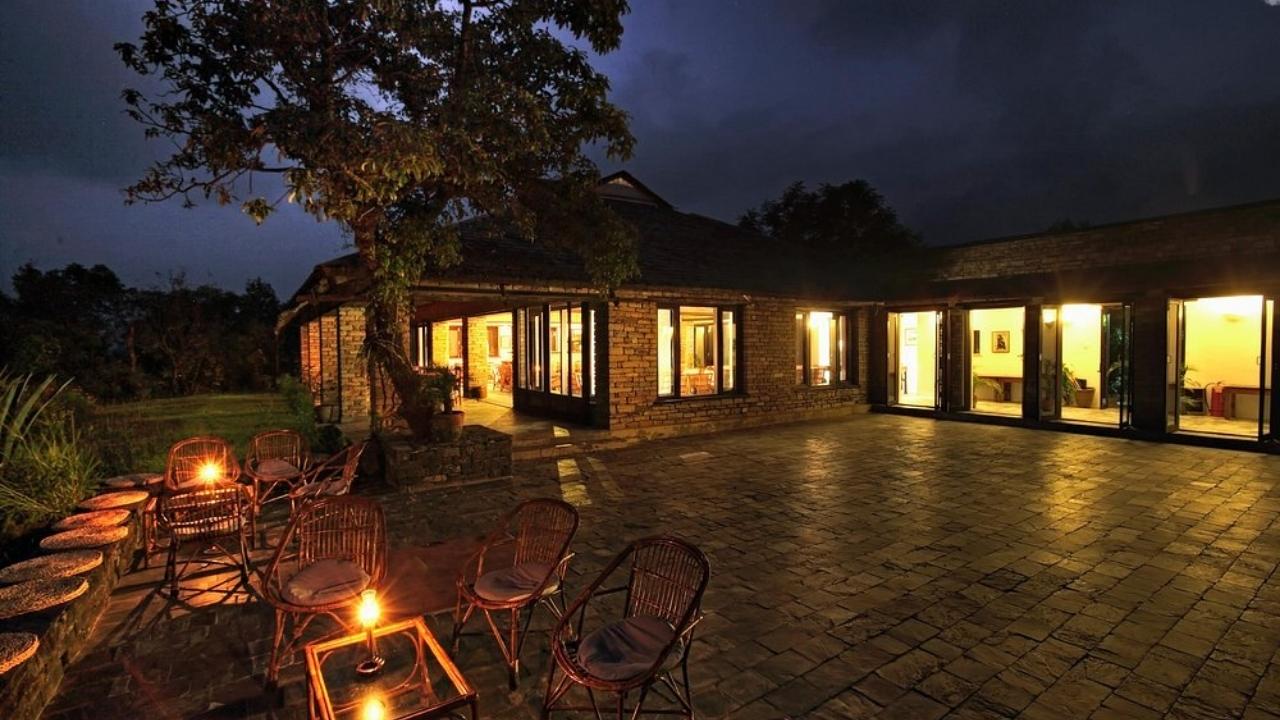
There are deliberately no televisions; instead, there is a library named for Lt. Col. James O.M. Roberts, the Gurkha officer and mountaineer credited with founding Nepal's first trekking company, who used this same hilltop to scout radio-mast sites decades before the lodge existed. The kitchen runs on produce from its own organic gardens, and the property holds GSTC Travelife Gold certification for sustainable tourism, one of the more credentialed sustainability records of any hotel in the region.
Upper Mustang: Shinta Mani Mustang, in Full Detail
Elevation: 2,800m at the property; guided excursions range 2,700m to 3,800m
Suites: 29, across Junior, Ground Floor, Top Floor, and Balcony categories
Rate: $1,890 to $2,285 per night, all-inclusive, with a 5-night minimum stay
Architect: Bill Bensley
Signature Service: Private consultation and treatment with an 11th-generation Amchi (Tibetan medicine doctor)
Shinta Mani Mustang sits above Jomsom overlooking the Kali Gandaki Valley, the deepest gorge on earth, with the 7,000-metre Nilgiri Himal filling the opposite skyline. Every suite has floor-to-ceiling windows, and the interiors mix Tibetan textiles with upcycled furnishings, Irish linen, and artwork by Robert Powell. The spa runs to a plunge pool, steam room, and sauna rather than a standard treatment menu, and wellness consultations are led by a genuine hereditary Tibetan medicine practitioner rather than a generic wellness team.
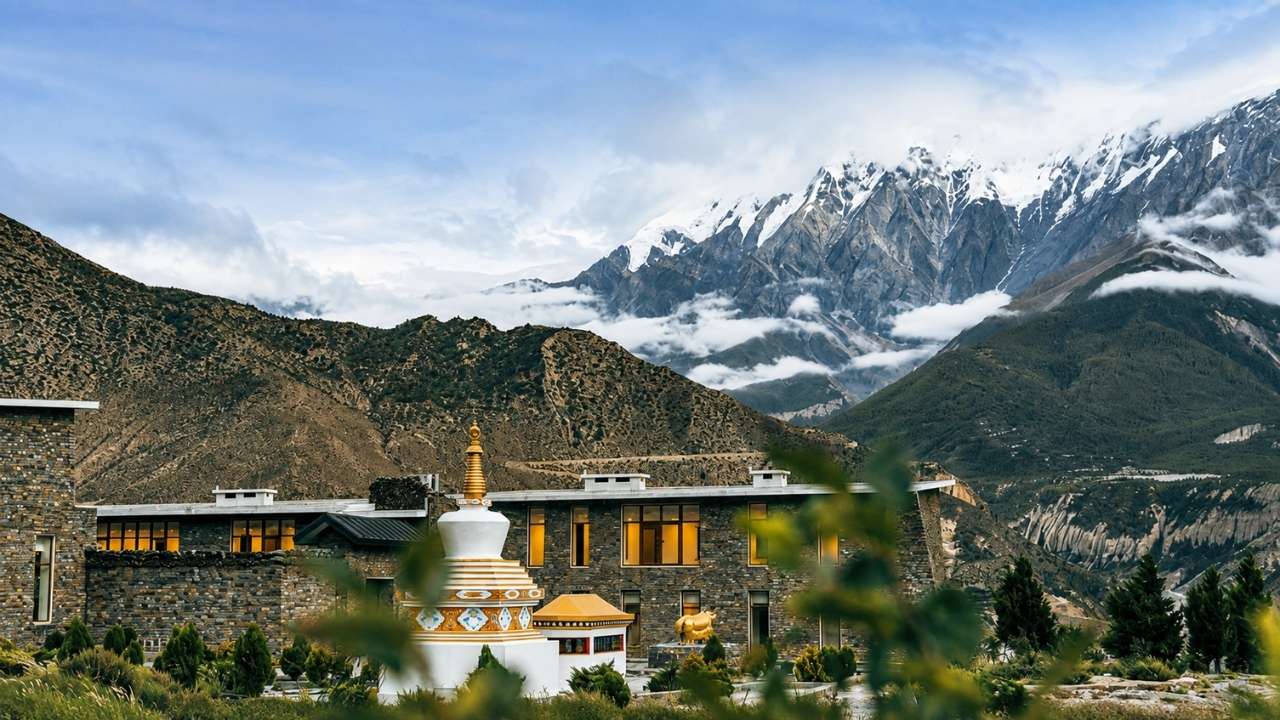
The "all-inclusive" rate is close to literal: meals, alcoholic and non-alcoholic drinks, private guided excursions through Lower Mustang, transfers, permits, and gratuities are all bundled in. The five-night program is built around actual movement through the region: horseback riding through the Mustang badlands, a hike to the 800-year-old Bon Buddhist village of Lubra, and visits to monasteries that see very few foreign visitors rather than positioning the hotel as a static resort with excursions bolted on.
The property closes every July and August for monsoon season. Guests can reach it by a scenic drive from Kathmandu via Pokhara and the Tatopani hot springs, a flight-plus-drive routing through Jomsom, or a direct helicopter transfer to the resort's own helipad, the fastest of the three, and the way most Robb Report-tier guests actually arrive.
Permits, Booking Lead Times, and Other Things Brochures Skip
None of these lodges operate as walk-up hotels, and the permit and booking logistics differ enough by region that they are worth laying out plainly.
Every trekker needs a Sagarmatha National Park entry permit (NPR 3,000, roughly $23, for foreign nationals) and a Khumbu Pasang Lhamu Rural Municipality entry permit raised from NPR 2,000 to NPR 3,000 in September 2024, so current 2026 guides list both fees at NPR 3,000, a combined NPR 6,000 (about $45), both purchased in Lukla or Monjo rather than in advance. A TIMS card is no longer required for the Khumbu region specifically; it was replaced by the rural-municipality permit in 2018.
Neither Yeti Mountain Home/MLN nor Everest Summit Lodges take walk-in bookings during peak season; rooms are allocated to trekking operators months ahead, so independent trekkers hoping to string together a premium-lodge itinerary on the fly in October or November will frequently find them full, even when a standard teahouse next door has space. Booking three to six months out is realistic for spring and autumn; inside six weeks, availability at Namche and Tengboche in particular gets thin.
The foothill circuit and the Annapurna Circuit both fall inside the Annapurna Conservation Area, which requires an ACAP permit (NPR 3,000, about $22 to 25) obtainable in Kathmandu or Pokhara before departure. A TIMS card (NPR 2,000 for individuals, NPR 1,000 through a group) technically still exists, but as of 2026 it is issued only through a registered trekking agency rather than sold independently, and on-trail checkpoints are largely verifying ACAP alone rather than enforcing both, a licensed guide has been legally mandatory in the Annapurna region since April 2023, which has made the old solo-trekker TIMS category largely moot.
Because Manang and Chame's high lodges are newer and smaller 14 rooms apiece and now sit within a day's drive of Kathmandu thanks to the road extension, they book out faster relative to their size than almost anything on the Everest side; a party of four hoping for consecutive nights at Manang Lodge during peak leaf-viewing season in October should expect to book at least two to three months ahead. The Ker & Downey/MLN foothill lodges around Ghandruk and Birethanti carry more inventory and are comparatively easier to secure with a few weeks' notice.
**Explore More: Annapurna Base Camp Heli Trek– Luxury Meets Adventure in the Heart of the Himalayas**
This is the one region on this list requiring a restricted-area permit rather than a standard conservation fee, since Upper Mustang was only opened to foreign trekkers in 1992 and remains tightly controlled. Through most of 2025 the Restricted Area Permit was a flat $500 per person for the first 10 days, with $50 per additional day; as of the 2026 reform, Nepal moved to a straight $50-per-person-per-day charge for however long a visitor is actually inside the restricted zone, on top of a separate ACAP fee (around $25 to 30).
Shinta Mani Mustang handles this permit application directly as part of its all-inclusive booking process, which is one of the quieter reasons its five-night minimum stay makes more sense than it first appears, even under the newer, more flexible daily pricing, a five-night program still runs a meaningful permit cost on top of the room rate, and the lead time to process a restricted-area permit (agencies report roughly 3 to 7 working days once documents are submitted) means this is not a booking anyone finalizes on short notice.
Across all three regions, the pattern holds: these are not properties to book the way you would book a city hotel. They are booked the way a trek is planned, through an operator or the lodge network directly, months rather than days ahead, with permits factored into both the cost and the timeline from the start.